
Portal Hound for e-commerce operations
Seller Central and Shopify for your offshore team, under named users from one company address.
Marketplaces are strict about who logs in and from where, and they suspend accounts that look shared. Portal Hound lets your offshore catalog, support and ads staff work as named users from one company-owned U.S. address, with a record of every session.
The problem
Marketplaces suspend first and ask questions later.
Amazon, Walmart and the ad platforms link accounts by login location and device. A seller account touched from five countries under one login is a suspension risk, and a suspended account is lost revenue by the hour.
Account health risk
Logins from many countries on a single seller login are exactly the pattern marketplaces flag.
Shared logins
One Seller Central login for the whole offshore team is against the terms and gives you no idea who changed a listing or issued a refund.
Ad account spend
Someone overspent a campaign at 3 a.m. Under a shared login, nobody did.
How it works
One button for workers. Full control for you.
You approve the portals
Add each platform your team works in. Portal Hound suggests the domains it needs, and nothing is reachable until you approve it.
Workers press Connect
They install a small app for Windows or Mac, sign in with their work email, and connect. There's nothing to configure.
Only approved portals go through
Those platforms are reached through your company's U.S. gateway, tied to that person and logged. Email, banking and everything else use the worker's own connection.
Platforms
The portals these teams approve first.
Any web platform can be approved. These are typical for e-commerce operations.
What you get
Named users per marketplace, one company address, a log of every change.
- Each team member is a named user with the right permissions in Seller Central, Shopify and the ad accounts; Portal Hound never shares a login.
- All marketplace logins leave from your company's one U.S. address, which is what account-health systems expect from an office.
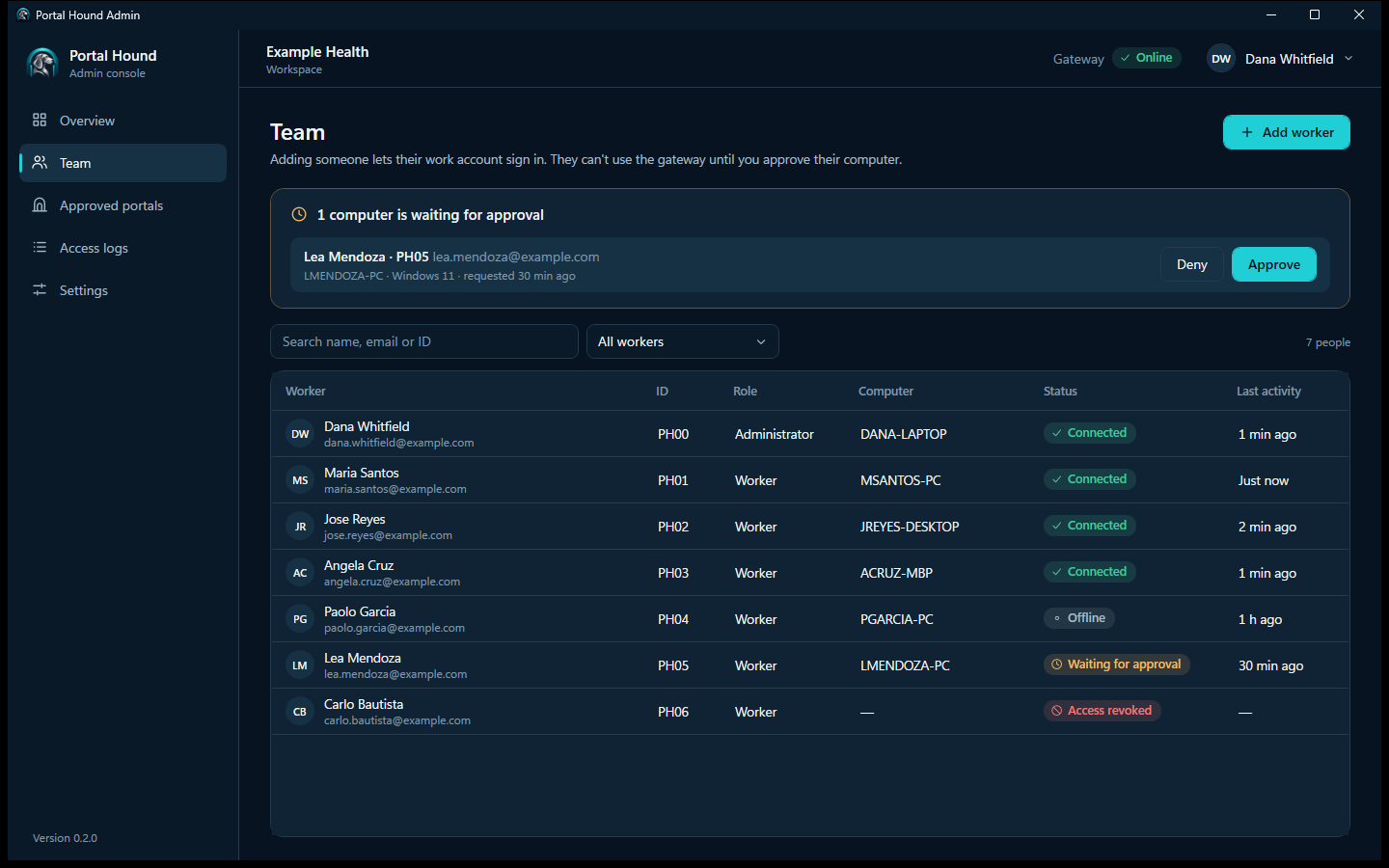
- Access logs show who reached which marketplace and when, so a listing change or refund has a name.
- Revoke access in one click when someone leaves, without rotating the store's passwords.
Requirements
Portal Hound is for teams already allowed to work offshore.
It controls and records how your team reaches portals. It doesn't change who is allowed to use them, or where from.
Your agreements must permit offshore access
Marketplace terms govern who may access a seller account and how. Secondary users must be added through the marketplace's own user permissions, and some marketplaces restrict offshore access for certain roles. Check before you start. Portal Hound is not a way around a marketplace's location rules.
Every person uses their own login
Your team members sign in to each platform with accounts issued to them, in the role they need. Portal Hound never shares, stores or fills in a login, and it isn't for working as somebody else.
Regulated data stays your responsibility
Customer order data is covered by consumer privacy law in several states and countries. Your policies and training still apply.
Tell your team access is logged
The access log records which person reached which platform and when. Tell them, and follow the privacy and employment rules where they work.
Portal Hound doesn't guarantee access to any portal. The companies that run them decide who may use their systems. Full requirements.
Questions from e-commerce operations
Will Amazon see our offshore staff?
Amazon sees named secondary users, added through Seller Central's user permissions, signing in from your company's U.S. address. That's the arrangement Amazon's terms describe; it isn't a way to hide where someone is.
Can it be used to run multiple seller accounts?
No. Portal Hound is one company's gateway for its own authorized staff. Operating multiple seller accounts is governed by the marketplace's rules, which it doesn't change.
Does it handle 2FA?
Each user keeps their own two-factor method on each platform. Portal Hound doesn't touch sign-in; it only decides which sites go through the gateway.
Related
See Portal Hound with your own portals.
We'll show you the worker app and admin console, and talk through setting up a gateway for your team.